Angels
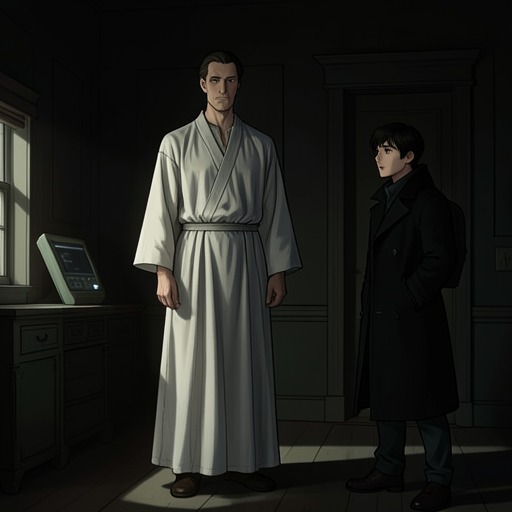
The Satanic VersesAngels in The Satanic Verses occupy an unsettled space between divine intermediaries, forces of nature, and figures formed by human perception. Their significance lies not simply in whether they exist, but in how their apparent messages pass through listeners, memories, and acts of interpretation. Through Gibreel Farishta’s changing sense of himself as an archangel, and through Mahound’s uncertain encounters with revelation, the novel makes angelic authority at once consequential and difficult to separate from human agency.
Nature and Place in the World
The novel raises the question of whether angels have wings and whether human beings can fly, but the question does not settle the status of either angels or miracles. Flight and transformation belong to a narrative world in which what appears impossible may be experienced as real, while the source of that experience can remain uncertain. A young listener’s early conviction that a supernatural world existed gives this uncertainty a personal history: ordinary visible things seemed only partly present, as if more of reality continued beyond what the eye could see. The supernatural thus enters not as a separate realm with neatly established borders, but as a possibility already pressing against everyday perception.
Angels are also described as intermediaries between the Deity and humanity and as controllers of nature. Yet their position is not simply one of command. The novel’s account of their relation to human beings suggests that the forces angels represent can be mastered through human knowledge; in that sense, the human being is not merely the passive recipient of angelic power. This produces a deliberate tension: angels may govern or mediate forces beyond ordinary human control, while their relation to humanity can also be understood as subordinate. Their authority is real within the story, but it is not uncomplicated.
Gibreel Farishta and Angelic Agency
Gibreel becomes the novel’s central, unstable embodiment of angelhood. At one point, the narration describes an apparent reversal of agency: Saladin Chamcha wills, and Gibreel does what is willed. The formulation makes their extraordinary experience difficult to reduce to a single actor’s power. It leaves open whether Gibreel acts independently, answers another person’s will, or participates in an event whose explanation the narration cannot securely fix.
Later, Gibreel believes that his archangelic functions are returning. In a London ticket office, he identifies himself as the Angel, Gibreel, and urges Orphia Phillips to recite. As she speaks, he experiences her unexpressed desires as something that enables him to translate them back to her and make action possible. Their speech moves together, and he understands the encounter as a joining rather than as a message delivered from a wholly separate being. The scene gives angelic power a specific operation: Gibreel does not simply announce a command but appears to bring another person’s inward needs into expression.
That power has limits. During rush hour on the Embankment, drivers fail to notice him, and their indifference infuriates him. He understands that an archangel can speak only when human beings choose to listen. The scene counters the grandeur of his claimed office with public nonrecognition: the ability to appear as an angel does not guarantee that anyone will acknowledge the appearance. Angelic presence depends, in practice, on a human audience.
Revelation, Listening, and Interpretation
Mahound’s encounters with Gibreel show how that dependence on interpretation reaches the level of religious authority. Mahound tells Salman the Persian that he has learned a special kind of listening: he feels that Gibreel often knows what is in his heart and seems to come from within it. Revelation is therefore represented not as a simple transfer of words from an external speaker, but as an encounter in which listening and inward knowledge are difficult to distinguish.
During a later visionary encounter, Gibreel feels Mahound’s despair and doubts, yet does not know what he is supposed to say. Mahound recalls earlier miracles and presses the problem of why witnesses remain unconvinced. The scene gives the angel a paradoxical role: he is present at the moment of revelation, but presence does not ensure that he possesses or delivers an unmistakable message. When Mahound cries out the name of a sacred text, the scribes begin writing; he then recites two more verses without hesitation. Speech, reception, and inscription occur in sequence, but the sequence does not by itself resolve the source of the words.
After wrestling with Gibreel, Mahound wakes in the wilderness to find no winged creatures around him. He concludes that he has been deceived by the Devil in the guise of the archangel, and returns to the city intending to remove the verses he had memorized and recited. The episode sharply revises the apparent certainty of the earlier revelation. Mahound’s changed judgment gives the same encounter a different source and meaning, making angelic appearance inseparable from the possibility of misrecognition.
Salman the Persian’s later account extends this uncertainty from reception to writing. A dream in which he hovers over Mahound at Mount Cone recalls the earlier episode from what seems to be an archangel’s point of view; Salman wonders whether that perspective belonged instead to Shaitan. The possibility prompts him to alter the words he records. He changes small details in Mahound’s recitations, and Mahound does not notice. The episode makes the written transmission of revelation another vulnerable stage: the angelic perspective is remembered through a dream, while the record can be changed by a human scribe without the messenger detecting the difference.
Memory, Dreams, and the Limits of the Angel
Gibreel’s own dreams further destabilize any fixed distinction between angelic identity and imagined role. As he resumes the role of archangel, he gradually regains what he takes to be archangelic memory and wisdom. He recalls Semjaza and Azazel among angels expelled from Heaven, an episode linked in his memory to a race of giants. The recollection enlarges his sense of angelic history, but its gradual return also makes identity a process: Gibreel does not simply possess complete knowledge from the outset; he experiences it as coming back to him.
In another stretch of dreamlike wandering, Gibreel feels himself moving through several stories at once: he mourns Alleluia Cone, hovers over a Prophet’s deathbed, watches a pilgrimage toward the sea, and senses an adversary drawing him toward a final encounter. These overlapping roles give angelhood a form that exceeds a single scene or task, yet they also make it difficult to separate a coherent supernatural office from the states through which Gibreel passes. His dream of Mahound’s death includes a call to Azraeel, but the dream frame keeps the encounter within a world where vision and waking experience are not securely divided.
Human and Angelic Qualities
Angelic and demonic identities do not remain confined to supernatural beings. Saladin Chamcha reflects that human beings can themselves be demonic, while human conduct can also be angelic; he doubts that the circumstances around him require a supernatural explanation. This reflection does not simply disprove the existence of angels. Instead, it denies that moral and historical events must be assigned to invisible agents before they can be understood. The same novel that gives Gibreel an angel’s name and powers also makes human beings participants in, interpreters of, and potential substitutes for the forces angels represent.
The result is an intentionally unstable account of angelic agency. Angels can appear as messengers, as powers associated with nature, as voices whose authority depends on listeners, or as identities recovered through dreams. Their interventions may alter what people believe and do, yet revelation remains vulnerable to doubt, mistaken recognition, and revision by human hands. The angel in the novel is therefore neither merely an unquestioned guarantee of divine truth nor merely an empty metaphor: angelhood is a contested relation among presence, perception, speech, and belief.